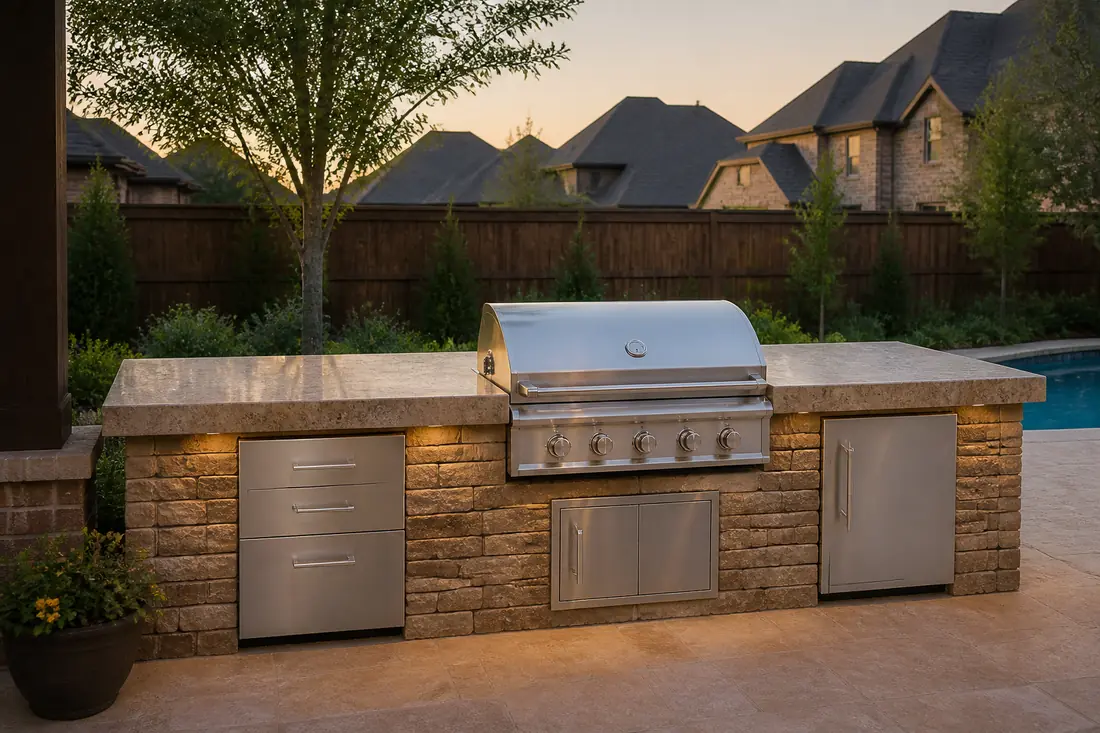
An outdoor kitchen is the one part of a house where the appliances are surrounded by cabinetry that was built on site, to no particular pattern, by somebody who may never have installed a gas appliance before.
Indoors, a range sits in a gap that the kitchen industry has standardized to within a fraction of an inch, next to cabinets built to match it. Outdoors, a grill is dropped into a masonry island designed around a patio, a view and a countertop run. The opening is whatever the drawing said. What is next to it is whatever the client liked in the showroom.
That is where most outdoor kitchen problems begin, and they are rarely dramatic. Nothing catches fire on the day. A cabinet door discolors over a season. A drawer front warps. Somebody notices the countertop overhang above the grill has gone brown. By then the island is built, the stone is on, and the fix means taking apart the thing you paid the most for.
The requirements that prevent this are in the fuel gas code, they are short, and one sentence in particular does most of the work — the sentence that says clearances are measured to things that move.
Last reviewed: 11 September 2026. The City of Frisco has adopted the 2024 International Fuel Gas Code, with amendments, effective 1 March 2026. The section numbers quoted below are from the 2021 edition, which is the text publicly readable online; the provisions described are long-standing ones, but numbering does move between editions and Frisco’s local amendments sit on top of whichever edition applies. Confirm a specific section against the adopted 2024 edition with the City before relying on it. What does not change between editions is the point this article turns on: for a listed appliance, the listing and the manufacturer’s installation instructions govern.
The appliance has to be listed for outside
Before any measurement matters, there is a threshold question, and it is the one most often failed in a renovation rather than a new build.
Section 303.6 provides that “Appliances installed in outdoor locations shall be either listed for outdoor installation or provided with protection from outdoor environmental factors that influence the operability, durability and safety of the appliances.”
An indoor appliance is not a cheaper version of an outdoor one. It is a different product, certified against different conditions. Its burners, ignition, gas train and controls were tested in still, dry, temperate air. Outdoors they meet wind across the burner, humidity, freeze-thaw, insects in the orifices and ultraviolet on every polymer component.
The failure mode is not usually a fire. It is an ignition system that stops working reliably after two seasons, a control valve that seizes, or corrosion in a place where corrosion means a leak. Those are expensive, and the warranty position on an appliance installed outside its listing is not a good one.
Section 305.1 states the general rule that everything else hangs on: “Equipment and appliances shall be installed as required by the terms of their approval, in accordance with the conditions of listing, the manufacturer’s instructions and this code.” The manufacturer’s instructions are not advisory literature. They are part of what the code requires.
The listing itself is named. Section 623.1 provides that cooking appliances “designed for permanent installation, including ranges, ovens, stoves, broilers, grills, fryers, griddles, hot plates and barbecues, shall be listed in accordance with ANSI Z21.1, ANSI Z21.58/CSA 1.6 or ANSI Z83.11/CSA 1.8 and shall be installed in accordance with the manufacturer’s instructions.”
Those three standards are worth knowing by number, because they are what separates a built-in appliance from a patio one. ANSI Z21.58/CSA 1.6 covers outdoor cooking gas appliances; ANSI Z21.1 covers household cooking gas appliances; ANSI Z83.11/CSA 1.8 covers commercial equipment. A rolling barbecue bought on a forecourt is not necessarily listed for permanent installation at all, and dropping one into a masonry surround does not make it so.
The sentence that governs island design
Section 305.8, Clearances to Combustible Construction, is where an outdoor kitchen is won or lost:
Heat-producing equipment and appliances shall be installed to maintain the required clearances to combustible construction as specified in the listing and manufacturer’s instructions. Such clearances shall be reduced only in accordance with Section 308. Clearances to combustibles shall include such considerations as door swing, drawer pull, overhead projections or shelving and window swing. Devices, such as door stops or limits and closers, shall not be used to provide the required clearances.
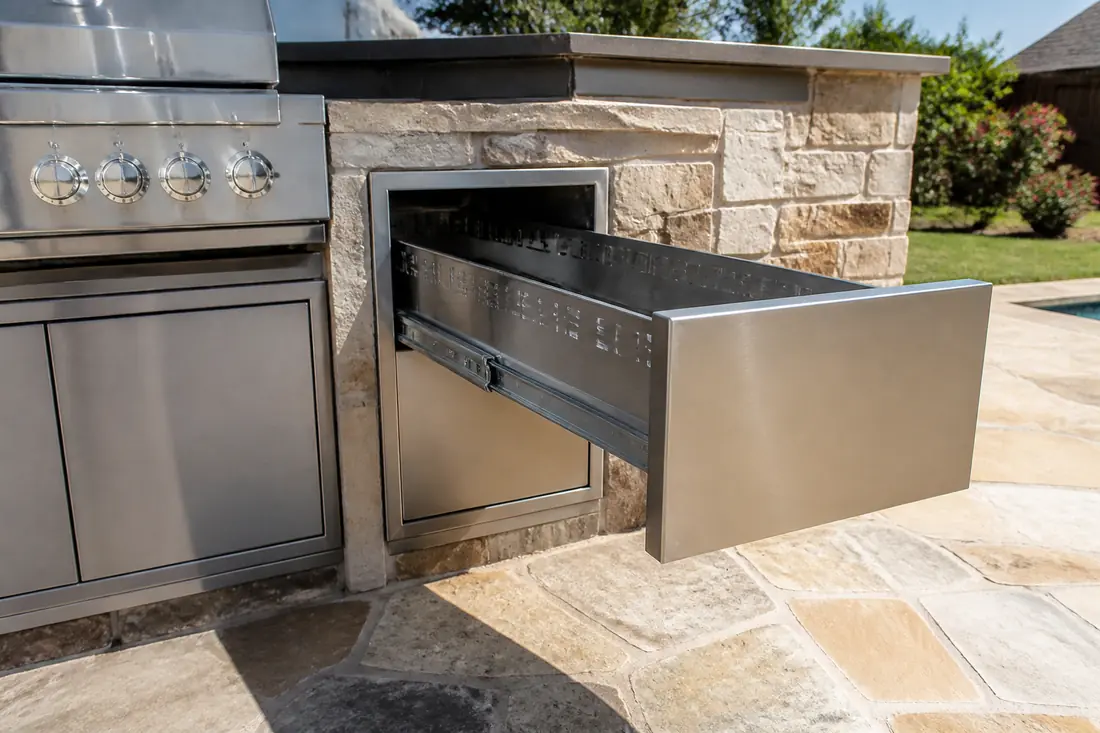
Read the third sentence again, because it is unusual and it is the whole point. Clearance is not measured to where the cabinetry sits. It is measured to where the cabinetry goes — the arc of a door as it swings, the position of a drawer front when the drawer is fully out, the reach of a shelf above.
In a built-in island, that changes the geometry of almost every layout people naturally want. A door hung to swing toward the grill is closer to the grill, for clearance purposes, when it is open — which is exactly when somebody is standing there using it. A deep drawer beside a grill puts its front, and whatever is combustible about it, a foot and a half further into the space when open.
The fourth sentence closes the obvious escape route. You cannot fit a door stop to limit the swing and call the clearance satisfied. Devices “such as door stops or limits and closers, shall not be used to provide the required clearances.” The geometry has to work with the hardware doing whatever it can do.
What “combustible” covers, and what it does not
Two misreadings are common, and they run in opposite directions.
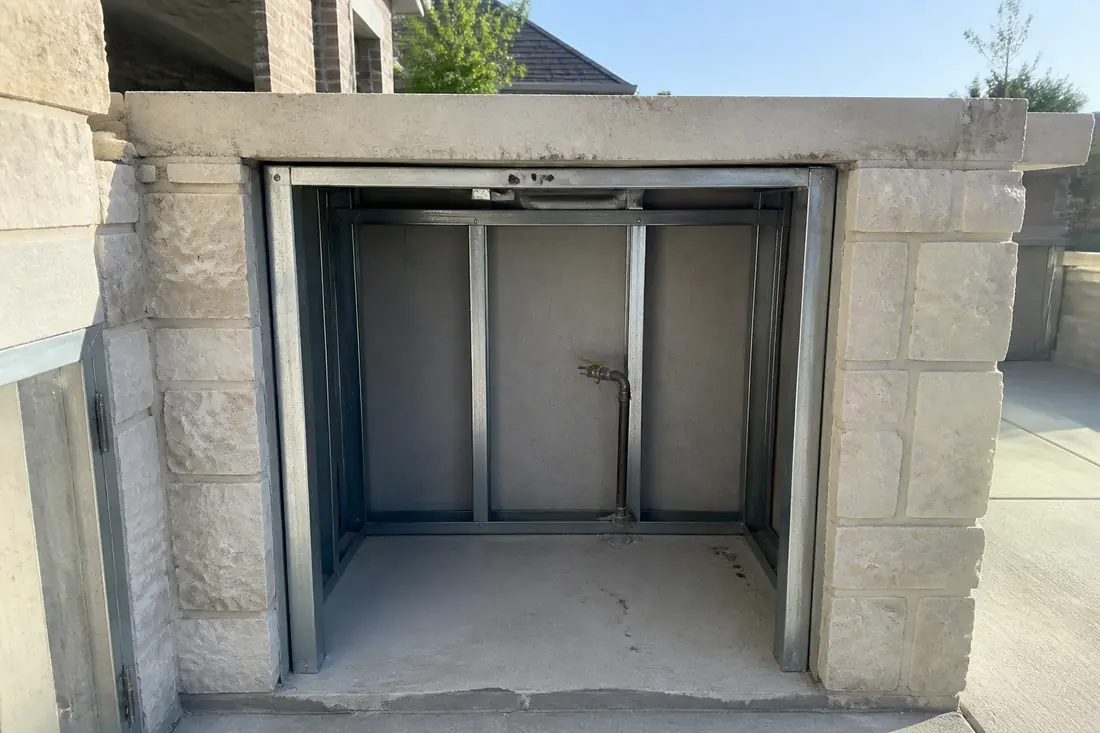
The first is that a stone or masonry island is automatically fine. The facing may be non-combustible while the structure behind it is not. Islands are frequently framed in timber, or in steel studs sheathed with a board that is not what the clearance assumed, and then faced in stone. What matters is the construction the heat reaches, not the surface you can see.
The second is that everything in an outdoor kitchen must be non-combustible. That is not what the code says either. It says clearances to combustible construction must be maintained as specified in the listing and the manufacturer’s instructions, and that they may be reduced “only in accordance with Section 308.” Section 308 provides the recognized reduction methods, in Table 308.2 with accompanying figures — specified assemblies of shielding and air gaps, not an invitation to improvise a heat shield.
So a timber-framed island is not forbidden. It has to be detailed to the clearances the appliance’s listing requires, or to a Section 308 reduction, and that detail has to be decided before the framing goes up.
Overhead is a clearance too
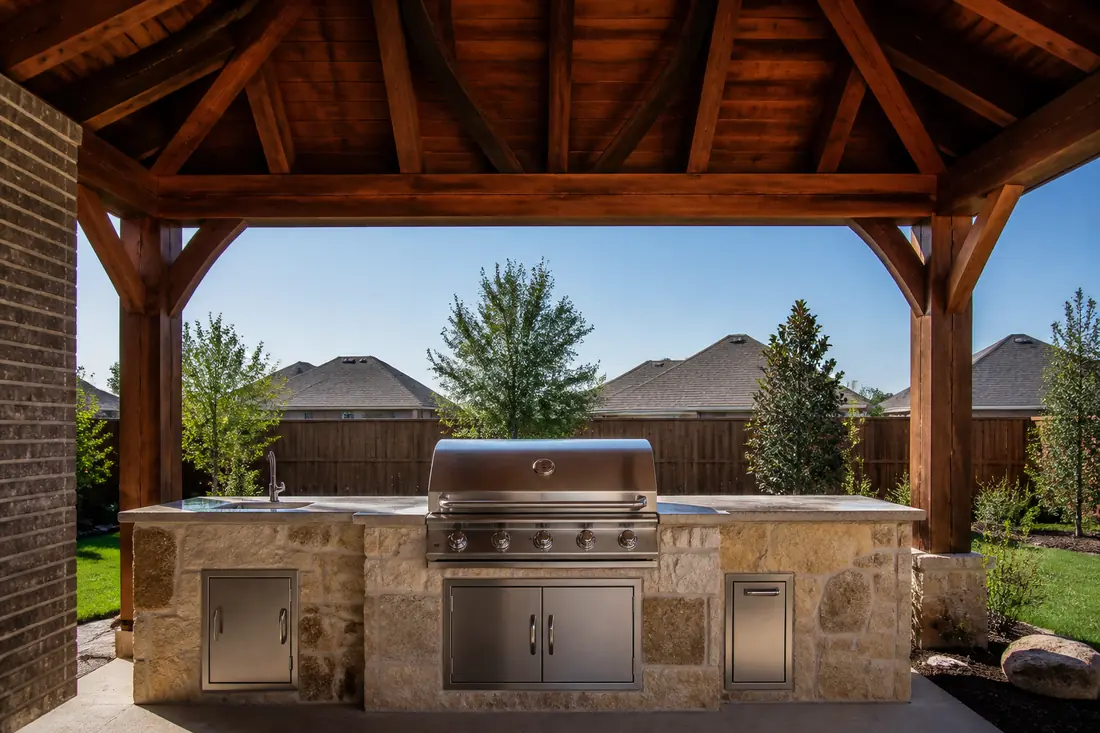
“Overhead projections or shelving” sits in the same sentence as door swing and drawer pull, and outdoors it covers three things in practice: a countertop overhang or raised bar above the grill, a shelf or cabinet run over the cooking surface, or the roof of the structure the whole kitchen sits under.
Pergolas and patio covers are where this gets missed most often in North Texas, because the cover is frequently a separate project, sometimes added later, and it is easy to think of it as shade rather than as construction above an appliance. A timber patio cover directly over a grill is combustible construction in the appliance’s overhead clearance zone, and the required distance comes from the appliance’s listing.
The same applies to a vent hood, where one is fitted — its clearances are its own, from its own listing, and they do not substitute for the grill’s.
What a builder should settle before framing
The order matters more here than in almost any other part of a build, because the island is masonry and the appliances are chosen late.
Select the appliances first. Every clearance in the design comes from a specific model’s listing and installation instructions. An island framed to generic dimensions and then fitted with whatever was in stock is guesswork.
Get the installation instructions on the table. Not the brochure. The instructions give the cutout dimensions, the required clearances to combustible construction on each side and above, and any requirement for a non-combustible liner or an insulated jacket.
Draw the doors and drawers open. On the plan, in their fully open positions. This is a five-minute exercise that catches the most expensive mistake on the job.
Decide the island’s internal construction. Combustible or not, and if combustible, what detail achieves the clearance.
Settle the overhead. Countertop overhangs, raised bars, shelving and the patio cover, together, before anyone commits to a grill position.
What drives the cost
There is no meaningful single price for an outdoor kitchen without knowing the appliance schedule, the island’s construction, how far the gas and power have to run and what the patio is built on. Clearance requirements move several items:
- Appliance selection. Outdoor-listed appliances cost more than indoor equivalents, and that difference is not optional.
- Island construction. A non-combustible framing and liner detail costs more than timber and stone facing, and is often the cleanest way to resolve tight clearances.
- Layout. Where clearances force the grill away from the cabinetry run, the island gets longer. Length is countertop, and countertop is expensive.
- The gas run. Distance, pipe sizing for the total appliance load, and whether the route can be trenched or has to be cut through paving.
- The overhead structure. Whether the cover has to be modified, raised, or detailed differently above the cooking zone.
Three mistakes worth avoiding
Buying the appliances last. The island is built to their clearances, so choosing them after the masonry is up inverts the whole sequence.
Moving an indoor appliance outside. Section 303.6 is explicit, and a kegerator, wine fridge or warming drawer intended for a kitchen interior is the most common version of this.
Treating the patio cover as a separate job. It is construction above a gas appliance, and it belongs in the same conversation as the grill. Our guide to protecting an outdoor kitchen through a North Texas freeze covers the other seasonal question these builds raise.
Before you sign
Ask which specific appliances the design is built around, and ask to see the clearance figures from their installation instructions. Ask what the island is framed in, and how the clearance to that framing is achieved. Then ask the question that separates a designer from a draughtsman: has anyone drawn the doors and drawers in their open positions?
The sequence that saves money is to fix the appliance schedule before the island is framed. Everything else in an outdoor kitchen can be adjusted late. The hole the grill sits in, and the things that swing into it, cannot.
This guide explains fuel gas code requirements in plain language and is not legal advice. The code edition and amendments adopted by your jurisdiction, the appliance’s listing and its manufacturer’s installation instructions control what is actually required.
Sources
- City of Frisco — Adopted Codes. The City’s own register of adopted codes, recording the 2024 International Fuel Gas Code with amendments, effective 1 March 2026, alongside the other 2024 I-codes adopted on the same date.
- International Fuel Gas Code, 2021, Chapter 3 — General Regulations, as adopted for Texas. Outdoor locations at Section 303.6; general installation and the status of the listing and manufacturer’s instructions at Section 305.1; clearances to combustible construction, including door swing, drawer pull and overhead projections, at Section 305.8; permitted clearance reduction methods at Section 308 and Table 308.2.
- International Fuel Gas Code, 2021, Chapter 6 — Specific Appliances, as adopted for Texas. Listing standards for permanently installed cooking appliances — ANSI Z21.1, ANSI Z21.58/CSA 1.6 and ANSI Z83.11/CSA 1.8 — at Section 623.1.