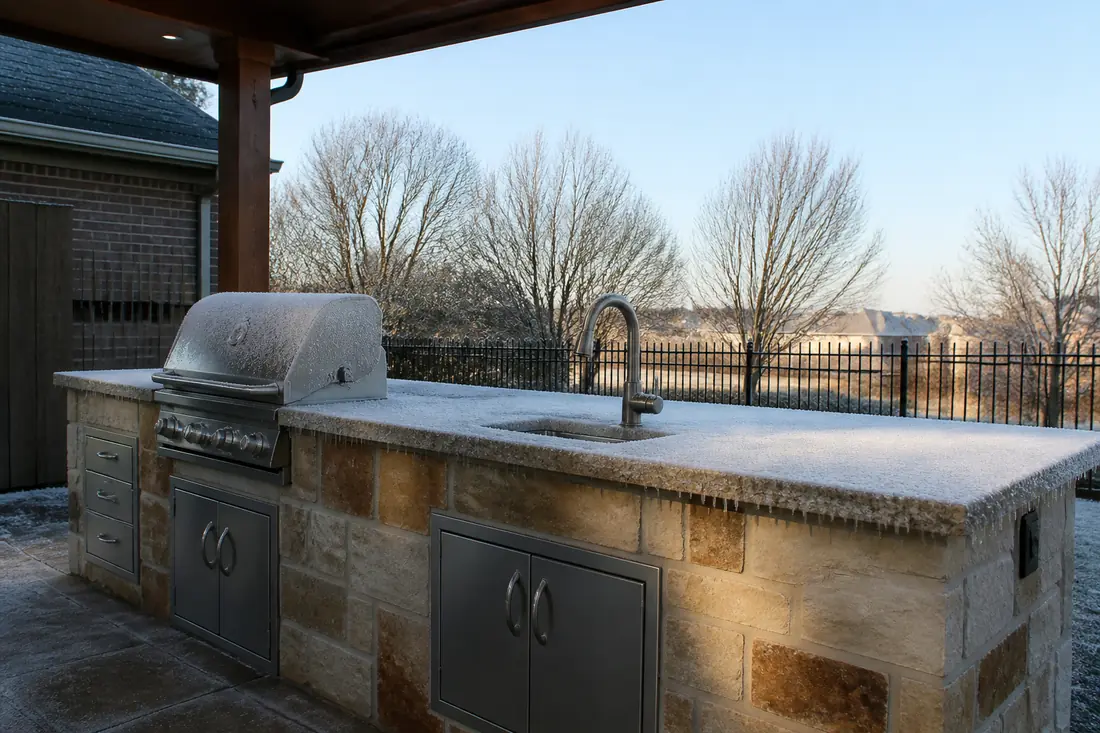
The first warm Saturday in March is when people find out.
The grill has not been touched since November. Somebody turns the water back on for the outdoor sink, walks away, and comes back to a wet patio — or worse, to nothing visible at all, because the split is inside the island and the water is running down into the base where nobody can see it. The freeze happened six weeks ago. The bill arrives now.
That gap between the damage and the discovery is the entire problem with cold weather and outdoor kitchens in North Texas, and it is why the subject gets so little attention here. Nobody is standing outside in an ice storm watching their kitchen fail. They are inside with the power out, thinking about other things entirely. By the time anyone looks, it is spring, the weather is pleasant, and the connection between the two is easy to miss.
An outdoor kitchen is a small building with water and gas running through it, sitting outside, built in a region that designs almost exclusively for heat. That is a reasonable priority for most of the year — the appliance guidance, the material choices and the shade planning are all aimed at August. But the failures come from the other direction, and they concentrate in the parts that were specified as though they were indoors.
None of this argues against building one. It argues for making three or four decisions at design stage that cost nothing then and are expensive to retrofit later.
What February 2021 actually did
The reference event is well documented, and it is worth being precise about it, because the numbers get repeated loosely.
The National Weather Service office in Fort Worth recorded 139 consecutive hours at or below freezing at DFW International Airport, from 5pm on 13 February to noon on 19 February 2021. The low at DFW was −2°F on 16 February, and the official event snowfall was 5.0 inches across the 14–17 February storm. NOAA places the wider event across 11–20 February and calls it the coldest winter storm for Texas since December 1989.
One detail in the NWS record deserves more attention than the headline figure: 139 hours ties for fifth place for consecutive hours below freezing at DFW. It was not unprecedented. Longer cold spells are in the record, which means the design question is not whether 2021 repeats, but whether the kitchen survives something in that range at all.
Two features of the event matter more than the temperature.
Duration rather than depth. One freezing night does very little to an outdoor kitchen — daytime sun thaws whatever cooled overnight. Six consecutive days below freezing removes that recovery entirely, and gives cold time to work into enclosed cabinet spaces and the middle of masonry mass, which is where the plumbing runs.
The power went out. Any protection that depends on electricity — heat tape, a cabinet heater, a recirculating pump — stopped working for the households that lost supply, during the coldest part of the event. A freeze strategy that assumes power is a strategy that is absent exactly when the weather is bad enough to need it.
Why outdoor plumbing gives up before indoor plumbing
Water expands as it freezes and a closed pipe has nowhere to put it. The split is rarely at the tap. It happens in the run behind the cabinet, at whichever point is least insulated and most exposed, and that point is usually invisible.
Three things make an outdoor kitchen worse than the equivalent run inside a house.
It sits on an exterior wall or in a freestanding island, with no conditioned space anywhere near it. The cabinet is deliberately ventilated, because enclosures containing gas appliances need air movement — and that same ventilation carries cold air straight through the cavity the water lines occupy. And the runs are long and lightly used, so water that has been standing still since October freezes more readily than water in a line somebody uses twice a day.
Put together, an outdoor sink line can be the coldest plumbing on the property while being the plumbing nobody thinks about.
Design it so it can be drained by someone who is not thinking about it
The protection that works is unglamorous and mostly geometric. It has to survive being operated by a person in a hurry the night before a hard forecast.
   house                          outdoor kitchen island
   ┌──────────┐
   │ shut-off │═══════════════════╗
   │  valve   │   supply run       ║   ┌─────────────┐
   └──────────┘   slopes back ◄────╢   │  sink /     │
    reachable      toward the      ║   │  ice maker  │
    without        drain point     ║   └─────────────┘
    going outside                  ║
                              drain point
                              at the low end

   Schematic only. The point is that the run falls toward a drain
   the owner can actually open — not that the valve sits here.
Three decisions do most of the work:
A dedicated shut-off for the outdoor kitchen, somewhere reachable in bad weather. A valve in a garage or utility space gets used. A valve that requires crossing an icy patio does not.
A run arranged so it will actually drain when isolated. This is the one that gets missed. Shutting off the supply while the pipe still holds a full run of water protects nothing at all — the trapped water freezes exactly as it would have.
A drain point at the low end, and the habit of opening the faucet afterwards so the line can vent rather than hold a vacuum against itself.
Where a sink or ice maker is in the design, the same logic applies to the waste side and to any filtered or chilled water line feeding it. Those are frequently added late, in small-diameter tubing, along whatever route was available — which describes the most vulnerable pipe on the whole installation.
Gas is a different problem, and a permitted one
Gas lines do not split the way water lines do, and a correctly installed, tested system is not usually what fails in a cold snap.
What does change in extreme cold is behavior at the regulator and the appliance, particularly on propane, where vapor pressure falls as the temperature drops. A tank that keeps up comfortably in mild weather may not deliver in a hard freeze, and moisture present in a system can cause its own trouble at regulators.
The more useful point at design stage is that this is permitted, inspected work with clearance and material requirements attached, and those requirements exist regardless of the weather. Frisco adopted the 2024 International Fuel Gas Code, with amendments, effective 1 March 2026 — alongside the 2024 International Plumbing Code, the 2024 International Residential Code and the 2024 International Mechanical Code on the same date, and the 2023 National Electrical Code from February 2024.
Anyone who priced a project against the previous cycle is working from a superseded set. Gas line installation for a built-in appliance is not a component swap, and the inspection route is worth following on a new run rather than establishing the position afterwards. Frisco’s plans examiners take questions directly, which is the cheapest call in the whole project.
Outdoor-rated and outdoors are not the same claim
An appliance sitting outside is not the same as an appliance built for it.
Outdoor-rated refrigeration is made for ambient swings that indoor units are not, but even outdoor-rated equipment carries a manufacturer’s stated minimum operating temperature, and running below it is outside the design envelope. End-of-season procedures vary enough between brands that the documentation is worth reading rather than assuming — a unit that wants draining and a unit that wants powering down are different instructions.
Grills are mostly indifferent to cold. Their vulnerable parts are the ones everything else shares: igniters, control components, and any water sitting somewhere it was not meant to.
Which returns to the pattern that opened this piece. Equipment rarely fails during the freeze. It fails on first use afterwards, when something that cracked in February is pressurized or powered in April.
Stone takes the slow damage
Countertops and masonry do not fail dramatically. They accumulate.
Porous stone absorbs water; water in the pores freezes and expands; repeated cycles produce spalling, surface loss and occasional cracking. It is the same mechanism that breaks up exterior concrete, and it is driven by the number of freeze-thaw cycles rather than by any single hard night — which makes an ordinary North Texas winter, with its repeated crossings of freezing, more relevant than 2021 was.
Denser and properly sealed materials resist it better than porous unsealed ones, so countertop selection for an outdoor build is a durability decision before it is an appearance one.
Standing water is what multiplies the cycles. Surfaces that pond, joints that hold water, and drainage that sends runoff across masonry instead of away from it all raise the count the material actually experiences.
The hour that prevents most of it
Before the first hard forecast:
- Shut off and drain the outdoor water supply, including any filtered or ice-maker line.
- Open the faucet after shutting off, so the run vents and empties instead of holding a vacuum.
- Read the appliance guidance for the specific units and follow the stated end-of-season procedure.
- Clear standing water from countertops, cabinet bases and any low point that holds it.
- Assume the power will fail. Anything that protects the kitchen only while energized should not be the only thing protecting it.
That is an hour in November against opening a masonry island in March to find out where a line let go. The kitchens that come through hard winters intact are generally not the ones with the most protection specified. They are the ones that could be isolated and drained in ten minutes by somebody who was busy.
Planning a build, or repairing one that did not come through a winter? Talk it through at design stage — a shut-off in the right place and a run that falls the right way cost nothing to specify and cannot easily be added later. More on outdoor kitchen design and construction around Frisco.
Sources
Checked 3 September 2026. Code editions and adoption dates change — confirm the current position with the City of Frisco before relying on the dates above.
- NWS Fort Worth — February 2021 Winter Event — DFW consecutive-hours, minimum temperature and snowfall records
- NOAA NCEI — The Great Texas Freeze, February 11–20, 2021
- City of Frisco — Adopted Codes
- Texas State Law Library — Gas and Fuel Codes