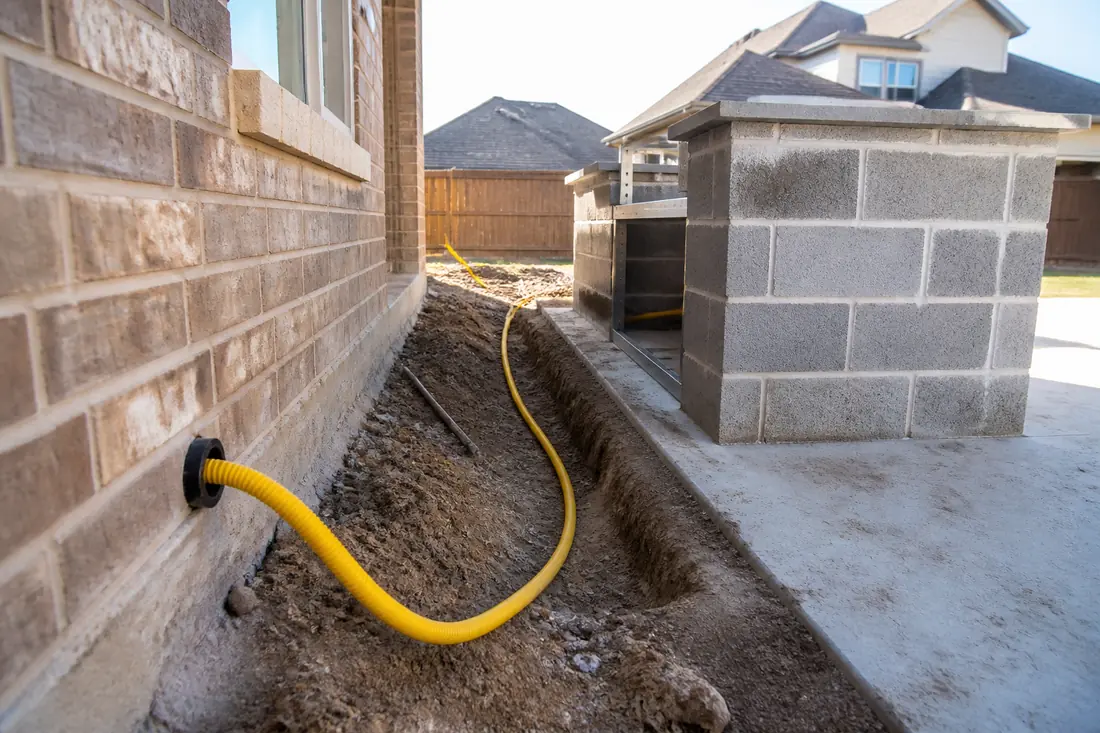
The conversation about the gas line usually happens twice. Once when the island is being laid out, where it is about Btu ratings and whether the meter can carry a grill, a side burner and a future pizza oven. And once at the end, when somebody puts a soap solution on the joints and watches for bubbles.
Both of those conversations are about gas escaping. Neither of them is about electricity, and the rule in this article is an electrical one. It governs the flexible corrugated tubing that most builders now run to a backyard kitchen, it has a wire size and a distance in it, and the distance is the part that catches people out on a large lot.
There is a second thing in it that catches out a particular kind of homeowner: the one with an older house plumbed entirely in rigid black steel, who is adding a single flexible run out to a new grill island. That one new segment changes what the code asks of the whole gas system in the house, not just the part that was added. Nothing about the existing piping has moved, and the requirement that applies to it has.
The requirement itself is explicit, and it is short. It sits in Section 310 of the fuel gas code and in Section G2411 of the residential code, and it costs very little to do when somebody thinks about it during the rough-in. It costs considerably more to retrofit through a finished stone veneer.
Why CSST bonding is a rule of its own, and rigid steel pipe is not
Corrugated stainless steel tubing, almost universally called CSST, is the yellow or black flexible line that comes off a reel. It bends around framing instead of being cut and threaded at every change of direction, which is why it took over residential gas piping, and it is thin where rigid black steel is thick.
The fuel gas code treats the two differently, and the split is visible in the section numbering. Section 310.1 covers “Pipe and Tubing Other Than CSST”. It asks that each aboveground portion of such a system that is likely to become energized be electrically continuous and bonded to an effective ground-fault current path, and then it says something that resolves most of those cases on the spot: gas piping other than CSST is considered to be bonded where it is connected to an appliance that is connected to the equipment grounding conductor of the circuit supplying that appliance. A steel line feeding an appliance that is plugged in or hard-wired has, in the code’s view, already met the requirement.
Section 310.2 covers CSST, and it does not offer that shortcut. It requires that the piping system be electrically continuous and bonded to the electrical service grounding electrode system, or, where one is provided, to the lightning protection grounding electrode system.
The code does not explain itself, but the structure of it says what the concern is. A requirement that reaches past the appliance circuit and lands specifically on the grounding electrode system, with a named alternative of the lightning protection electrode system, is a requirement about energy arriving from outside the building rather than from a fault inside it.
The National Weather Service describes the mechanism in general terms, and the sentence worth carrying away is this one: “Metal does not attract lightning, but it provides a path for the lightning to follow.” The agency lists conduction along wires and metal surfaces that extend outside as the cause of most indoor lightning casualties, and separately describes a side flash, where current jumps from a struck object to something nearby. Bonding does not stop any of that. It gives the energy a deliberate, low-resistance route to the same ground everything else in the house is tied to, so that a difference in potential does not have to find its own way across.
What Section 310.2 asks for, in four parts
The CSST bonding requirement and its subsections are short enough that a homeowner can hold the whole thing in their head:
- Where it attaches. The bonding jumper connects to a metallic pipe, pipe fitting or CSST fitting (310.2.1). It lands on metal that is part of the gas piping, not on the tubing jacket.
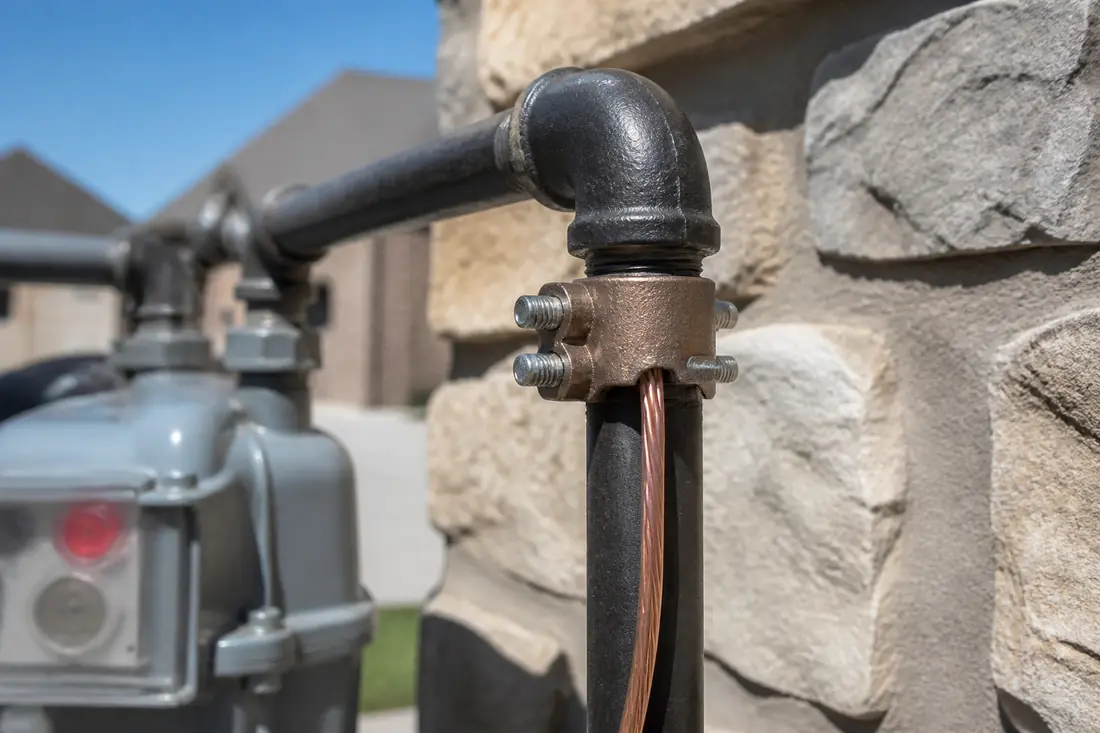
- What size. The jumper is not smaller than 6 AWG copper wire or equivalent (310.2.2). That is a heavy conductor, noticeably thicker than the ground wire in a lighting circuit, and the size is a floor rather than a recommendation.
- How far. The length of the bonding jumper between its connection to the gas piping and its connection to the grounding electrode system is not to exceed 75 feet, which the code also gives as 22,860 mm (310.2.3).
- What the connection has to be. Bonding connections are made in accordance with NFPA 70 (310.2.4), and the devices used for making them are listed for the application in accordance with UL 467 (310.2.5). A general-purpose hardware-store clamp is not a listed bonding device.
One related line sits just above, in Section 309.1, and it answers a question people often ask in the wrong direction: gas piping is not to be used as a grounding electrode. Bonding the gas system to the grounding electrode system and using the gas system as the grounding electrode are opposite things, and only one of them is permitted.
The 75 feet is wire, not pipe, and that distinction matters
This is the most commonly garbled part of the rule, and getting it right changes where the problem actually lies.
The limit is on the bonding jumper. It is not a limit on how long the gas line may be, how far the grill island may sit from the house, or how much CSST is in the system. A property can have two hundred feet of gas piping and a perfectly compliant twelve-foot jumper, because the jumper runs from an accessible metallic fitting on the gas piping to the grounding electrode system at the electrical service. Section 310.2.1 governs what the jumper lands on, a metallic pipe, pipe fitting or CSST fitting, and says nothing about where along the system that connection has to sit. Placement is a question of access and routing rather than a rule about proximity to the meter.
So the question is not how far away the outdoor kitchen is. The question is how far apart the gas piping and the electrical service grounding electrode system are, measured along the route a heavy copper conductor can actually be run.
That is where a large suburban lot starts to matter. On many houses the gas meter and the electrical service sit on the same side, a short walk apart, and the jumper is trivial. On others they are on opposite corners. Detached structures, a meter relocated during a remodel, a kitchen fed from a branch that was easiest to pick up at the far end of the house: each of these lengthens the route. An outdoor kitchen project is often the first time anybody has had reason to open up and look at the gas system since the house was built, which is why it is the point at which the question tends to surface.
The code anticipates the problem and supplies the answer in the same sentence. Where 75 feet cannot be met, additional grounding electrodes may be installed, and those additional electrodes are themselves to be bonded to the electrical service grounding electrode system, or to the lightning protection grounding electrode system where one is provided (310.2.3). Exceeding the distance is a design condition with a stated remedy, not a reason the project cannot proceed. It does add a ground rod and a bonding run to the scope, and that is the sort of thing worth knowing before the bids are compared rather than after.
One flexible segment changes the requirement for the whole system
Here is the part that affects more houses than the distance limit does.
Section 310.2 opens by naming what it applies to: “CSST gas piping systems and piping systems containing one or more segments of CSST”. Read that second phrase slowly. It does not say the CSST portion of a piping system. It says a piping system that contains one or more segments.
A house plumbed entirely in rigid black steel is sitting under Section 310.1, and is very likely already considered bonded through its appliance circuits. Run one flexible line from an interior tee out through the wall to a new grill island, and the gas piping system in that house now contains a segment of CSST. The bonding requirements of 310.2 apply to the system, and the shortcut in 310.1 no longer resolves it.
Nothing about the existing steel changed. The classification of the system did. This is worth asking about directly when a bid for an outdoor kitchen gas line comes in, because an installer pricing only the new run may not have priced a bonding jumper back to the service at all.
Yellow tubing, black tubing, and the trap in the newer product
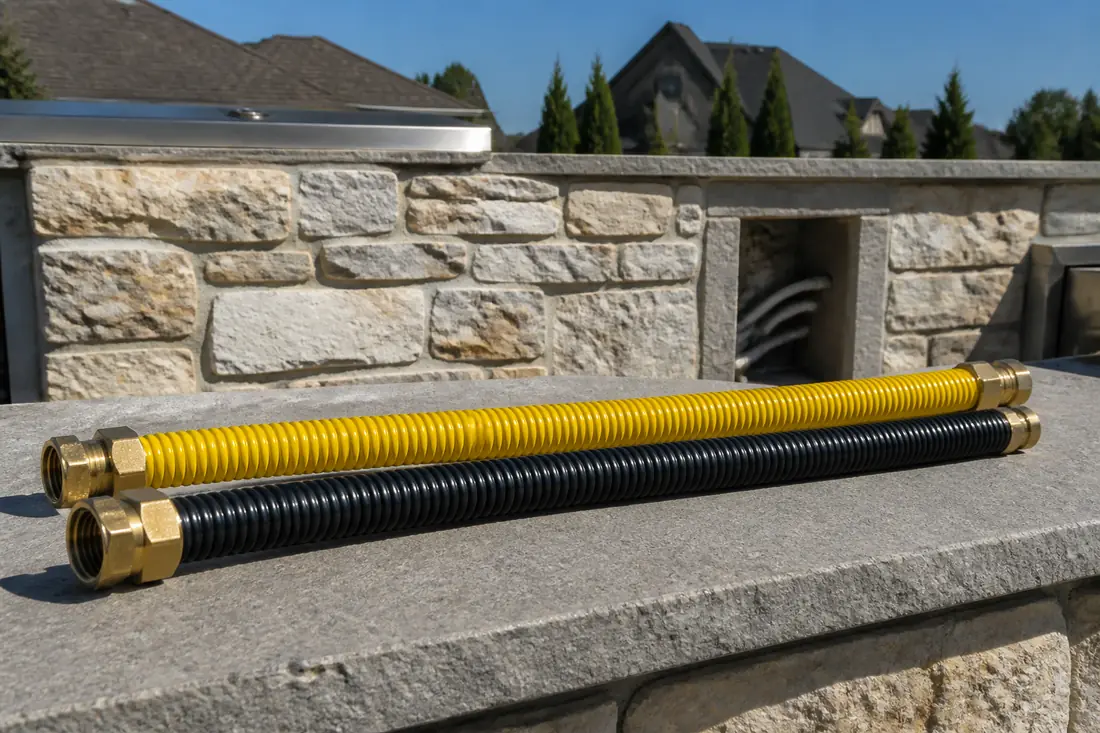
Some CSST is listed with an arc-resistant jacket or coating system in accordance with ANSI LC 1/CSA 6.26. In practice this is the black jacketed product, as against the older yellow. Section 310.3 gives it an easier path: arc-resistant jacketed CSST is to be electrically continuous and bonded to an effective ground-fault current path, and it is considered bonded where it is connected to an appliance that is connected to the appliance grounding conductor of the circuit supplying that appliance (IFGC 310.3, carried as IRC G2411.3). That is the same practical treatment steel pipe gets under 310.1.
Then comes the sentence that catches mixed installations. From 310.3: “Where any CSST component of a piping system does not have an arc-resistant jacket or coating system, the bonding requirements of Section 310.2 shall apply.”
Any component. A house largely re-piped in black arc-resistant tubing, with one surviving yellow stub behind a dryer or under a crawl space from an earlier job, is a piping system in which a CSST component lacks the arc-resistant jacket. The whole system goes back under 310.2, with the 6 AWG jumper and the 75-foot limit.
Two consequences follow for an outdoor kitchen. The first is that running arc-resistant tubing to the new island does not, on its own, buy the easier treatment if anything else on the property is yellow. The second is the reverse, and it is the one people get wrong more often: adding a short length of yellow tubing to an otherwise arc-resistant system, because it was what was on the truck, changes the requirement for everything.
Which code book applies to a backyard in Collin or Denton County
The text quoted above is from the International Fuel Gas Code, Section 310, in the 2021 edition published for Texas. The same requirement also appears in the International Residential Code, which is the book that governs a one- or two-family dwelling, where it is numbered Section G2411 in Chapter 24. The residential version carries its fuel gas parentheticals alongside the section numbers, so G2411.2.2 is annotated (310.2.2), and the language is the same: not smaller than 6 AWG copper wire or equivalent, not to exceed 75 feet.
Knowing that both numbering systems exist is useful when reading a correction notice. An inspector citing G2411.2.3 and a plan reviewer citing 310.2.3 are pointing at one requirement.
Which edition a particular city enforces, and whether it has local amendments, is a question for that city’s building department rather than for an article. Texas municipalities adopt and amend the model codes individually, and the adopted edition changes over time. Confirm the current adopted edition and any local amendment before relying on a section number in a permit conversation.
What a professional looks at, in order
An installer who has thought about this walks the property before pricing, and the sequence is roughly this.
First, what the gas piping is actually made of, which usually means looking in a few places rather than one. An attic, a crawl space or the run at the meter will show whether the house is steel, yellow CSST, black arc-resistant CSST, or some accumulation of all three from successive remodels.
Second, whether a bond already exists. A 6 AWG conductor clamped to a gas fitting, often though not necessarily one near the meter, and running toward the service is reasonably easy to spot once somebody knows to look for it. Its absence is not proof of a defect on an older all-steel house, because 310.1 may already be satisfied, but it is the first thing that has to be resolved once CSST enters the picture.
Third, the physical route between the gas piping and the grounding electrode system, and the length of conductor it would take. That is the measurement that decides whether 310.2.3 is satisfied outright or whether a supplemental electrode is in scope.
Fourth, the electrical side of the outdoor kitchen itself, since a built-in refrigerator, task lighting and receptacles arrive with their own grounding and bonding requirements and are usually trenched at the same time as the gas. Doing the gas trench and the electrical trench as one coordinated piece of work is ordinary practice, and separating them is how a finished patio gets opened twice.
Common mistakes
Treating the bonding jumper as the electrician’s problem and the gas line as the plumber’s. The requirement sits in the fuel gas code and is satisfied with an electrical conductor and a listed clamp. On projects where the two trades are separately contracted, it is the item most likely to fall into the gap.
Using an unlisted clamp. Section 310.2.5 asks for devices listed for the application in accordance with UL 467. A clamp that holds the wire tightly is not the same as a clamp listed for bonding, and an inspector will know the difference on sight.
Assuming the appliance circuit covers it. It does for steel pipe under 310.1 and for fully arc-resistant systems under 310.3. It does not for a system containing non-arc-resistant CSST, which is the configuration most likely to be present.
Bonding to something convenient rather than to the grounding electrode system. The destination named in 310.2 is the electrical service grounding electrode system, or the lightning protection grounding electrode system where one is provided. A nearby water pipe or a stray ground rod with no bond back to the service is not that.
Finishing the island before the inspection. A bonding connection buried behind stone veneer, or a jumper run under a poured patio, is awkward to verify and expensive to correct. The connection wants to stay reachable.
What drives the cost
There is no meaningful single price for this work without knowing the length of the conductor run, whether the route is open trench or has to pass through finished construction, whether a supplemental grounding electrode is required by the 75-foot limit, and what the existing gas piping turns out to be once somebody looks at it.
The variable with the widest spread is the last one. A property that reads as a simple grill island addition, and then turns out to carry three generations of gas piping with a yellow segment nobody expected, has a different scope than the one that was bid. That discovery is cheap during a walk-through and expensive after the trench is backfilled.
Before you commit to a bid
Ask what the gas piping on the property is made of, and how the installer established that rather than assumed it. Ask whether a bonding jumper is included in the price, what size it is, and where it will terminate. Ask what the measured distance is between the proposed connection point and the grounding electrode system, and what happens if it exceeds 75 feet. Ask whether the gas and the electrical work are being coordinated into one trench and one inspection.
Four questions, and the answers tell you quickly whether the person quoting has walked the property or priced a standard package.
If you are also working out whether the structure over the kitchen changes what the code asks of it, our guide to when an outdoor kitchen stops counting as outdoors covers the enclosure threshold and what it does to ventilation and makeup air. The bonding requirement here applies either way.
This guide explains the requirements in plain language and is not legal advice. The adopted code edition in your jurisdiction, any local amendment, and the building official’s determination for a specific property control what is actually required.
If you are planning a built-in kitchen and want the gas and electrical scope established before the trenching starts, that is a conversation worth having at the layout stage rather than at the inspection.
Sources
- International Fuel Gas Code, 2021, Chapter 3 General Regulations, as published for Texas. Section 309.1, gas piping not to be used as a grounding electrode. Section 310.1, pipe and tubing other than CSST, and the appliance equipment grounding conductor provision. Section 310.2, the scope phrase “CSST gas piping systems and piping systems containing one or more segments of CSST” and the requirement to bond to the electrical service grounding electrode system or the lightning protection grounding electrode system. Section 310.2.1, point of connection. Section 310.2.2, the 6 AWG copper minimum. Section 310.2.3, the 75-foot limit and the supplemental grounding electrode remedy. Sections 310.2.4 and 310.2.5, NFPA 70 and UL 467. Section 310.3, arc-resistant CSST, ANSI LC 1/CSA 6.26, and the clause returning a mixed system to Section 310.2.
- International Residential Code, 2021, Chapter 24 Fuel Gas, as published for Texas. The same requirement in the code that governs a one- or two-family dwelling, carried as Section G2411 with the fuel gas section numbers in parentheses: G2411.2.2 (310.2.2) for the 6 AWG jumper, G2411.2.3 (310.2.3) for the 75-foot limit, G2411.3 (310.3) for arc-resistant CSST, and G2410.1 (309.1) for the grounding electrode prohibition.
- National Weather Service, “Lightning Science: Five Ways Lightning Strikes People”. The conduction mechanism and the sentence “Metal does not attract lightning, but it provides a path for the lightning to follow”, plus the descriptions of side flash and ground current. Cited for the mechanism only; the page does not discuss gas piping.