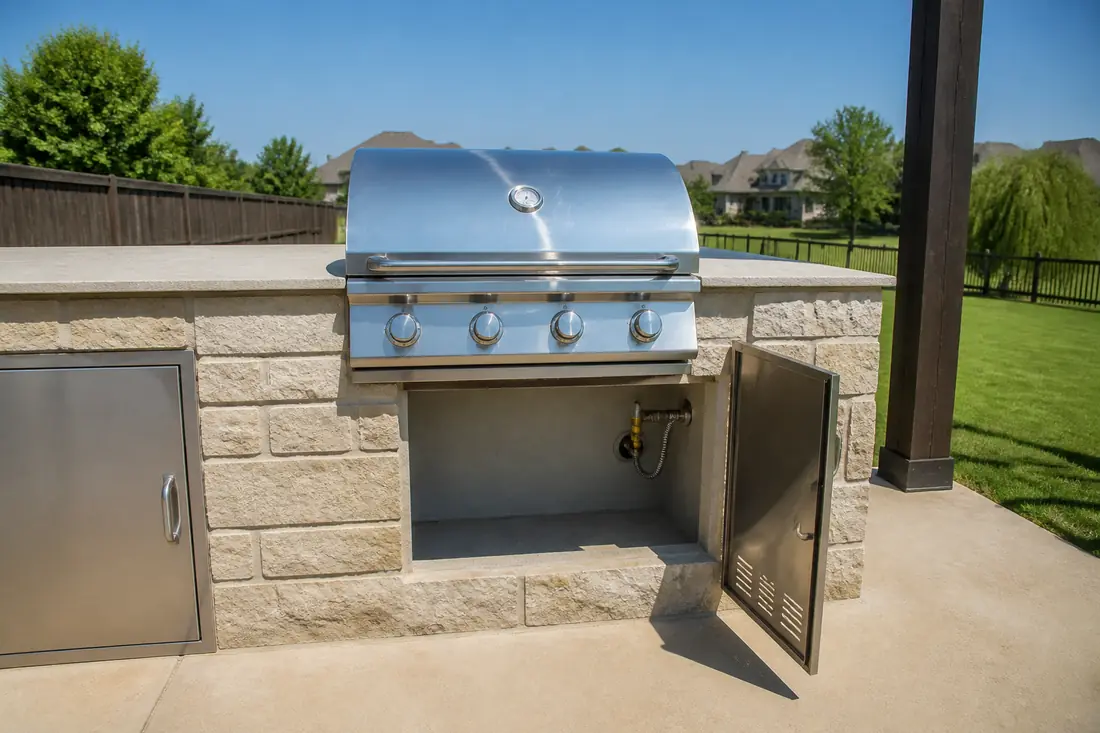
The design is finished and the slab is poured before the question comes up. The gas stub-out is on the house wall, where the builder put it, and the grill island is out at the edge of the patio, twenty-odd feet away. Somebody asks how the gas gets from one to the other, and the answer that comes back is a length of flexible connector.
That answer is wrong in at least three ways, and the reason it keeps getting given is not incompetence. It is that the fuel gas code writes nearly all of its appliance rules around a sentence that begins “the shutoff valve shall be located in the same room as the appliance.” A grill island on a patio in Prosper is not in a room. Three provisions that are unambiguous indoors therefore have to be read with some care outdoors, and one of them has a separate product listing written for exactly this case.
None of this is obscure. The sections are short and the numbers are specific, and the shutoff location, the connector type and length, the wall penetration and the sediment trap are the four items a plan review on a built-in gas island turns on. Settling them before the island is built costs nothing. Moving a valve or changing a penetration detail after the stone is set is a demolition job.
Last reviewed: 12 October 2026 against the 2021 International Fuel Gas Code and the 2021 International Residential Code as published for Texas. Section numbers are from those editions.
Which book, and why you will see two numbers
A one- or two-family dwelling is governed by the International Residential Code, and its fuel gas provisions sit in Chapter 24. That chapter reprints the fuel gas code with its own numbering and keeps the original number in parentheses, so the shutoff valve section appears as G2420.5 (409.5) and the connector section as G2422.1 (411.1). The text is the same.
This matters when you read a correction notice. An inspector citing G2422.1.2.1 and a plan reviewer citing 411.1.3.1 are pointing at one requirement, and arguing about which number is right wastes a week. Below, the fuel gas numbers are used because they are shorter, with the residential equivalent given where it helps.
Which edition a given city enforces, and what it has amended, is a question for that city’s building department. North Texas municipalities adopt and amend the model codes individually and the adopted edition changes over time. Confirm the current adopted edition and any local amendment before you rely on a section number in a permit conversation.
The shutoff valve: three routes, and only two work outdoors
Section 409.5 says each appliance shall be provided with a shutoff valve in accordance with Section 409.5.1, 409.5.2 or 409.5.3. That is all 409.5 does. The requirement lives in the three subsections, and they describe three different arrangements.
409.5.1, located within the same room. The valve shall be in the same room as the appliance, within 6 feet of it, and installed upstream of the union, connector or quick-disconnect device it serves. It shall be provided with access. For movable appliances such as cooking appliances and clothes dryers, a valve installed behind the appliance counts as provided with access.
409.5.2 is for vented decorative appliances, room heaters and decorative appliances installed in vented fireplaces. Their valves may be remote from the appliance where provided with ready access, permanently identified, and not serving another appliance. The piping from the valve to within 6 feet of the appliance has to be designed, sized and installed per Sections 401 through 408.
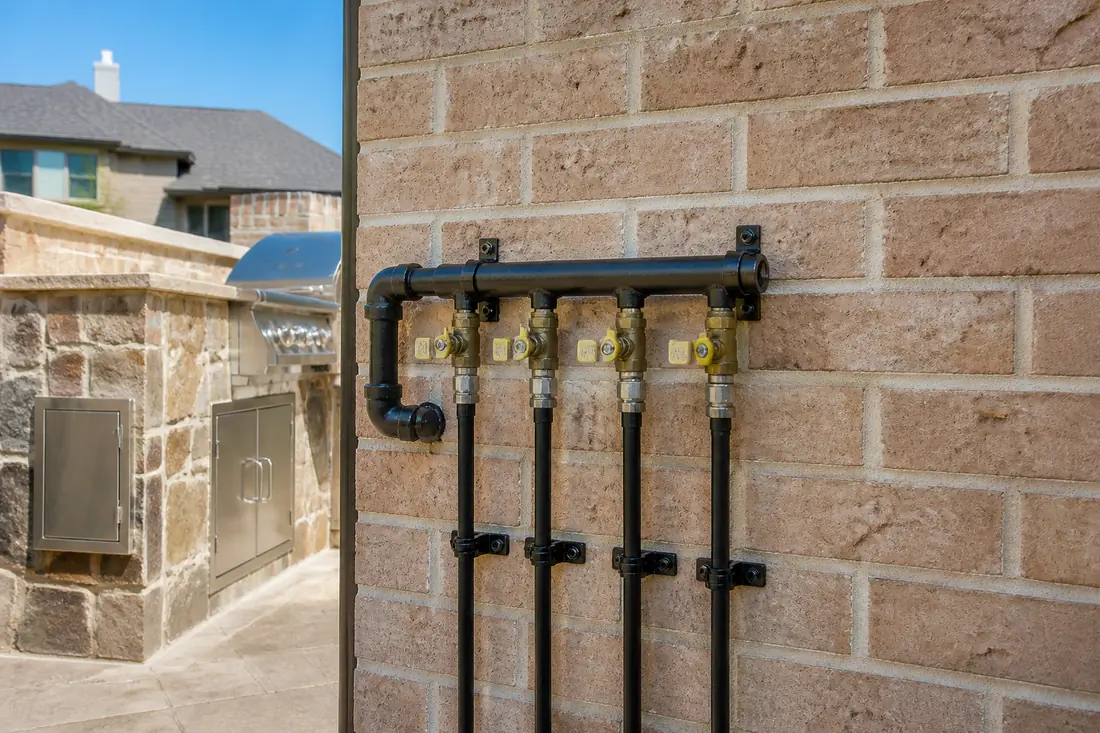
409.5.3, located at a manifold. Where the appliance shutoff valve is installed at a manifold, that valve shall be located within 50 feet of the appliance served, and shall be readily accessible and permanently identified. Again, the piping from the manifold to within 6 feet of the appliance follows Sections 401 through 408.
Read those three against a grill island. 409.5.1 does not say “within 6 feet” on its own; it says the valve shall be in the same room as the appliance, within 6 feet, and upstream of the connector, with access. Outdoors there is no room, so the subsection whose text expressly fits an island is 409.5.3, the manifold within 50 feet, readily accessible and permanently identified.
In practice a great many outdoor kitchens are built the other way, with a valve inside the island behind an access door. Whether that is accepted as satisfying 409.5.1 is a question for the authority having jurisdiction rather than one the section answers, and it is worth settling with the plan reviewer before the island is built rather than at inspection. The manifold route is the one that does not require the question to be asked.
Access and ready access are not the same word
This is the detail that decides where a valve may be hidden, and it turns on two definitions in Chapter 2 that most people read past.
Access (to) is “that which enables a device, appliance or equipment to be reached by ready access or by a means that first requires the removal or movement of a panel, door or similar obstruction.”
Ready access (to) is “that which enables a device, appliance or equipment to be directly reached, without requiring the removal or movement of any panel, door or similar obstruction.”
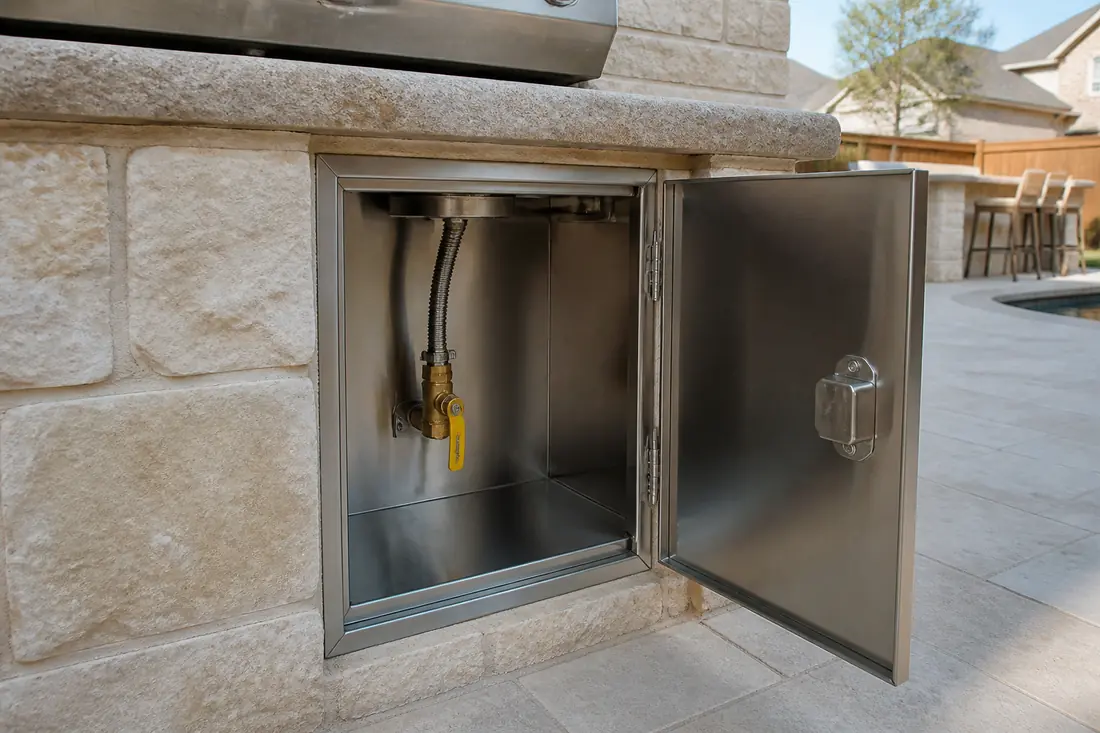
So the 6-foot valve under 409.5.1 needs access, and a valve behind a stainless door in the island face satisfies that much: opening a door is explicitly contemplated. The manifold valve under 409.5.3 needs ready access, which Chapter 2 defines as directly reachable without removing or moving any panel, door or similar obstruction. A manifold tucked inside a cabinet or behind a removable stone panel does not meet the standard the section sets for it.
That is why the two arrangements look so different in the field. One is a valve behind a little door. The other is a labeled bank of valves on an open wall, and the labels are not optional either: 409.5.3 requires the valve to be permanently identified.
The connector, and the listing written for outdoors
Section 411.1 gives a numbered list of the ways an appliance may be connected to the piping system. Do not rely on the numbers: the fuel gas code’s list and the residential code’s list are not the same length, because the fuel gas version carries two entries the residential one leaves out. Read the clauses, not the ordinals. Four of them matter for an outdoor kitchen, and the distinctions are not cosmetic.
Rigid metallic pipe and fittings is the plainest. Corrugated stainless steel tubing, installed per the manufacturer’s instructions, brings its own bonding requirement; the site’s guide to CSST bonding on an outdoor kitchen covers the 6 AWG jumper and the 75-foot limit that go with it.
Semirigid metallic tubing and metallic fittings is a third route, and the fuel gas code attaches its own limits to it: lengths “shall not exceed 6 feet” and “shall be located entirely in the same room as the appliance,” and the tubing “shall not enter a motor-operated appliance through an unprotected knockout opening.” Semirigid tubing matters later on, because it is named in one of the exceptions that lets anything pass through an island wall at all.
Listed and labeled appliance connectors complying with ANSI Z21.24/CGA 6.10 are the familiar indoor article, and the clause adds that they must be “located entirely in the same room as the appliance.” That is the room language again, and it is why the ordinary connector in the plumbing aisle is a poor fit for a patio.
The entry written for this situation is the one worth knowing by name: listed and labeled outdoor appliance connectors complying with ANSI Z21.75/CSA 6.27, installed per the manufacturer’s instructions. There is a separate product listing for outdoor use, and asking whether the connector on the truck carries it is a reasonable question to put to an installer.
One further entry covers the freestanding grill rather than the built-in one: listed outdoor gas hose connectors complying with ANSI Z21.54, used to connect portable outdoor appliances. The clause is specific about how that connection is made. The gas hose connection “shall be made only in the outdoor area where the appliance is used, and shall be to the gas piping supply at an appliance shutoff valve, a listed quick-disconnect device or listed gas convenience outlet.”
The word doing the work there is “portable.” A grill that drops into a masonry island and stays there is not the appliance that clause is describing, and a hose and quick-disconnect arrangement that would be perfectly correct for a cart grill on a patio is a different question once the grill is built in.
Six feet, measured along the centerline, and one connector
Section 411.1.3.1 sets the limit that catches the twenty-foot stub-out problem:
Connectors shall have an overall length not to exceed 6 feet. Measurement shall be made along the centerline of the connector. Only one connector shall be used for each appliance.
Three separate rules in three sentences. Six feet is the cap. It is measured along the centerline, so a connector routed in a loop inside an island is longer than the straight-line distance it covers. And one connector per appliance means two connectors coupled together to bridge a longer gap is not an option, however neatly it is done.
The section’s exception is the actual answer to a long run: rigid metallic piping used to connect an appliance to the piping system may exceed 6 feet, provided the connecting pipe is sized as part of the piping system in accordance with Section 402, and the location of the appliance shutoff valve complies with Section 409.5.
In other words, the distance from the house to the island is a job for pipe, not for connector. The connector’s six feet is the last stretch between the valve and the appliance.
Rigid pipe brings one obligation of its own worth knowing, at Section 411.1.6: an appliance connected by rigid metallic pipe requires a union fitting, and that union shall be accessible and located within 6 feet of the appliance. Six feet appears three times in this part of the code, attached to three different things.
Two shorter provisions round it out. Section 411.1.2 requires connectors and tubing to be installed so as to be protected against physical damage. Section 411.1.3.4 requires a shutoff valve not less than the nominal size of the connector ahead of the connector, per Section 409.5. And Section 411.1.4 covers appliances on casters or otherwise subject to periodic movement for cleaning or maintenance, which must be connected either by rigid metallic pipe or by a connector listed as complying with ANSI Z21.69/CSA 6.16.
What may and may not pass through the island wall
Here is the provision that most often turns into a correction notice, because the obvious way to build the thing is the way the code prohibits. Section 411.1.3.3:
Connectors shall not be concealed within, or extended through, walls, floors, partitions, ceilings or appliance housings.
A grill island has a wall and the grill has a housing. A flexible connector run from a stub-out behind the island, through the block or the framing, and up into the grill’s burner box is concealed within a wall and extended through an appliance housing, which is the thing the first sentence rules out.
The section then gives four exceptions, and two of them are how outdoor kitchens actually get built:
- Connectors constructed of materials allowed for piping systems under Section 403 may pass through walls, floors, partitions and ceilings where installed in accordance with Section 409.5.2 or 409.5.3. That is the pipe-grade route, and note that it points at the remote-valve and manifold arrangements rather than at 409.5.1.
- Semirigid tubing and listed connectors may extend through an opening in an appliance housing, cabinet or casing where the tubing or connector is protected against damage. “Cabinet or casing” is the exception that an island cavity relies on, and “protected against damage” is a condition, not a description.
The other two exceptions cover rigid steel pipe connectors through openings in appliance housings, and fireplace inserts factory-equipped with grommets or sleeves per the appliance listing.
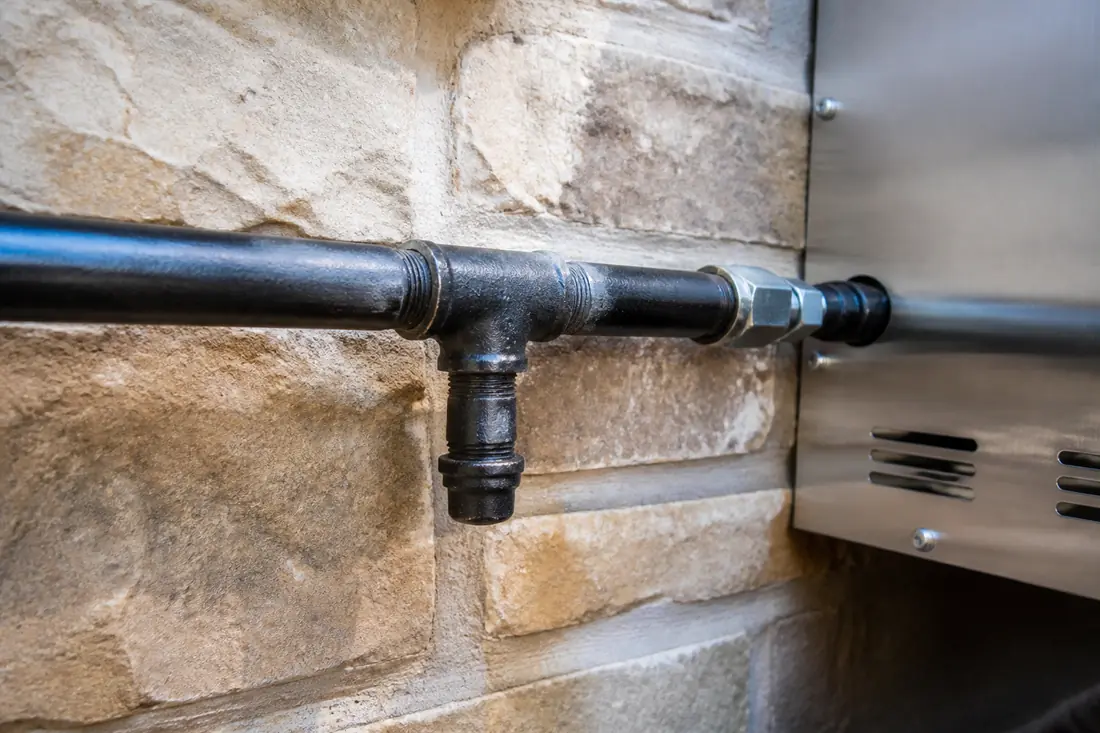
Read together, these say something fairly clear about how the gas should arrive. Pipe comes to the island. A valve sits inside the island with access to it. A short connector of the right type makes the last few feet through a protected opening. What does not work is a long flexible line buried in masonry.
The sediment trap, and the list that names outdoor grills
Section 408.4 requires that where a sediment trap is not incorporated as part of the appliance, one shall be installed downstream of the appliance shutoff valve and as close to the inlet of the appliance as practical. It may be a tee fitting with a capped nipple of any length installed vertically in the bottommost opening of the tee, as illustrated in Figure 408.4, or another device approved as an effective sediment trap.
Then comes a sentence that saves most grill installations a fitting:
Illuminating appliances, ranges, clothes dryers, decorative vented appliances for installation in vented fireplaces, gas fireplaces and outdoor grills need not be so equipped.
Outdoor grills are named. A grill island whose only gas appliance is the grill is very likely outside the requirement on that basis.
The thing to notice is how specific that list is. It names categories, not a general exemption for anything outdoors, and an outdoor kitchen frequently contains more than a grill: a side burner, a power burner for a stock pot, a gas griddle, a pizza oven, a patio heater, a fire feature, a gas appliance under a bar. Whether a particular appliance falls inside one of the named categories is a determination for the plan reviewer and the inspector, and it is a better question to ask during design than during inspection. The appliance’s own installation instructions are worth reading on this too, since the requirement only applies where a trap is not already incorporated in the appliance.
What a professional looks at, in order
An installer pricing a built-in island walks the job before quoting it, and the sequence is roughly this.
Where is the existing supply, and what is it? A builder’s stub-out on a wall tells you the point of connection but nothing about capacity. The run has to be sized for the total demand of everything the island will carry, which is a calculation rather than a guess, and the appliance list has to be settled before the pipe is sized.
How far is it, and across what? Twenty feet of lawn, a paver patio already laid, or a poured slab are three different excavations. This is usually the largest single variable in a quote and it has nothing to do with gas at all.
How many appliances? One grill argues for a single valve inside the island with access. Four gas appliances argue for a manifold, which then has to be somewhere with ready access and permanently identified, which is a decision about the look of the house as well as the code.
What is the island built of, and has it been built yet? Dropping a valve and a protected opening into a block island at framing stage is straightforward. Retrofitting one into a finished stone island is a different job.
Which appliances are going in, and what do their instructions say? Clearances, combustion air and whether a sediment trap is already incorporated all come from the appliance literature, and the literature arrives with the appliance, which is often after the island is built. Getting the cut sheets early is the cheapest thing on this list.
What drives the cost
There is no meaningful single price for running gas to an outdoor kitchen without knowing the distance and what the trench has to cross, the total demand of the appliance set and therefore the pipe size, the material the island is built from and whether it already exists, the number of appliances and therefore whether a manifold is involved, and what the permit and inspection process in that city requires.
What can be said is where the surprises come from. Opening a finished patio costs more than trenching lawn. Adding a second gas appliance late can push the pipe size up for the whole run rather than just the branch. And a valve or manifold that has to be relocated because it ended up behind a door that the code will not accept is a rework item with stone on top of it.
Four mistakes worth avoiding
Bridging the distance with flex. Two connectors joined, or one long one, to reach from a stub-out to an island. Section 411.1.3.1 caps a connector at 6 feet along its centerline and permits only one per appliance. The distance is pipe’s job.
Using an indoor connector outdoors. There is a listing specifically for outdoor appliance connectors, ANSI Z21.75/CSA 6.27, named in the list at Section 411.1. The ANSI Z21.24/CGA 6.10 connector in the same list carries the “entirely in the same room” condition, which is an awkward fit for a patio.
Putting the manifold behind a door. A 409.5.3 manifold valve must be readily accessible, and Chapter 2 defines that as directly reached without removing or moving any panel or door. The 6-foot valve under 409.5.1 only needs access, where a door is fine. The two sections use different words on purpose.
Assuming everything outdoors is exempt from a sediment trap. Section 408.4 exempts a specific list that includes outdoor grills. It is not a general outdoor exemption, and an island with several gas appliances in it is worth checking appliance by appliance.
Before you accept a scope of work
Ask which subsection of 409.5 the design relies on, and where the valve will physically be. If the answer is a manifold, ask where it will be mounted and how it will be labeled, because readily accessible and permanently identified are both requirements rather than preferences.
Ask what the connector will be and what it is listed to. A quote for a built-in island should be able to name ANSI Z21.75/CSA 6.27 or explain which of the methods listed in 411.1 it is using instead.
Ask how the gas enters the island, and which exception to 411.1.3.3 the detail relies on. “Through a protected opening in the cabinet” is an answer. “Through the wall” is not.
Ask whether the pipe has been sized for every appliance you might add, not just the ones on the drawing. Gas line installation is the part of an outdoor kitchen that is most expensive to revisit, because it is under the patio.
And get the appliance cut sheets before the island is built. The code sets the floor; the manufacturer’s instructions set the rest, and they are referenced by the code often enough that ignoring them is a code problem rather than a warranty one. The site’s guide to what counts as a clearance on a built-in grill is the companion to this one on that point.
The sequence that saves money is to settle the appliance list, then size the pipe, then decide where the valve goes, then build the island. Done in that order these four provisions cost nothing. Done in reverse, each of them is a reason to take stone off an island you have already paid for.
This guide explains code provisions in plain language and is not legal advice or a code determination. The edition adopted by your city, any local amendments, and the code official’s determination for a specific project control what is actually required.
Sources
- International Fuel Gas Code, 2021, Chapter 4 Gas Piping Installations, as published for Texas. The sediment trap requirement, the capped-nipple tee of Figure 408.4 and the exemption list naming illuminating appliances, ranges, clothes dryers, decorative vented appliances for installation in vented fireplaces, gas fireplaces and outdoor grills, at Section 408.4; the three appliance shutoff valve routes at Section 409.5, with the same-room, 6-foot, upstream-of-the-connector and access requirements at 409.5.1, the remote-valve provision for vented decorative appliances and room heaters at 409.5.2, and the 50-foot, readily accessible and permanently identified manifold provision at 409.5.3; the permitted connection methods listed at Section 411.1, including semirigid metallic tubing with its 6-foot and same-room limits, ANSI Z21.24/CGA 6.10 connectors located entirely in the same room, ANSI Z21.75/CSA 6.27 outdoor appliance connectors and ANSI Z21.54 outdoor gas hose connectors for portable outdoor appliances — nine entries in the fuel gas code against seven in the residential code, which is why this article names the clauses rather than their numbers; protection from physical damage at 411.1.2; the 6-foot connector limit measured along the centerline, the one-connector rule and the rigid metallic piping exception at 411.1.3.1; the prohibition on concealing or extending connectors through walls, floors, partitions, ceilings or appliance housings and its four exceptions at 411.1.3.3; the shutoff valve ahead of the connector at 411.1.3.4; the movable appliance provision and ANSI Z21.69/CSA 6.16 at 411.1.4; and the accessible union within 6 feet at 411.1.6.
- International Fuel Gas Code, 2021, Chapter 2 Definitions, as published for Texas. The definitions of “access (to)”, which permits reaching a device by first removing or moving a panel, door or similar obstruction, and “ready access (to)”, which requires the device to be directly reached without removing or moving any panel, door or similar obstruction.
- International Residential Code, 2021, Chapter 24 Fuel Gas, as published for Texas. The code that governs a one- or two-family dwelling, carrying the same provisions under its own numbering with the fuel gas section given in parentheses: the sediment trap and its exemption list at G2419.4 (408.4), the shutoff valve routes at G2420.5 (409.5) with the manifold provision at G2420.5.3 (409.5.3), the connection methods at G2422.1 (411.1), protection from damage at G2422.1.1 (411.1.2), the 6-foot single-connector limit at G2422.1.2.1 (411.1.3.1), the prohibited locations and penetrations at G2422.1.2.3 (411.1.3.3), the shutoff ahead of the connector at G2422.1.2.4 (411.1.3.4), the union within 6 feet at G2422.1.4 (411.1.6) and movable appliances at G2422.1.5 (411.1.4).